
Getting your Windows VPS setup wrong is not just an inconvenience. A misconfigured server can expose RDP ports to the internet, trigger GDPR violations, or grind your Sage or ERP system to a halt during peak business hours. For IT decision-makers and business leaders in Ireland, the cost of those mistakes is measured in downtime, legal exposure, and lost productivity. This checklist walks you through every critical factor, from core requirements to provider comparison, so you can deploy a Windows VPS that performs reliably, stays secure, and keeps your business fully compliant with Irish and EU regulations.
Table of Contents
- Identify your core requirements
- Confirm data center location and compliance
- Secure remote access and protect RDP
- Choose hardware and software for peak performance
- Compare top VPS providers: The checklist in action
- Our perspective: The checklist is the strategy
- Ready to deploy a Windows VPS that meets every item on your checklist?
- Frequently asked questions
Key Takeaways
| Point | Details |
|---|---|
| Match checklist to business needs | Tailor each checklist item to fit your precise uses and compliance demands. |
| Data center choice is critical | Select an Irish/EU provider to optimize latency and meet legal obligations. |
| Always secure remote access | A VPN for RDP and automated monitoring are mandatory to prevent breaches. |
| Hardware impacts performance | Prioritize NVMe, CPU, and licensing that align with your software stack. |
Identify your core requirements
With the stakes established, the first step is nailing down your core needs before you evaluate a single provider or configure a single server.
Too many businesses skip this step and end up either over-provisioning (paying for resources they never use) or under-provisioning (watching their ERP system crawl during month-end processing). Neither outcome is acceptable in an enterprise environment.
Start by mapping out exactly how the server will be used:
- Remote desktop access: How many concurrent users need to connect? Will they be running lightweight tasks like email and document editing, or resource-intensive applications like SQL Server or financial modeling tools?
- Enterprise applications: Applications like Sage, Xero, or custom ERP platforms have specific compatibility requirements. Enterprise apps like Sage require compatibility checks with Irish software versions and licensing structures before deployment.
- Database workloads: SQL Server instances demand significant RAM and fast storage. Plan for peak query loads, not just average usage.
- Web hosting or development environments: These add network throughput and security considerations to the mix.
Once you know the workload profile, match resources accordingly. For most Irish enterprise deployments, you should be looking at a minimum of 8GB RAM for multi-user remote desktop environments, 4 vCPUs for moderate application loads, and NVMe storage for any database-driven workload. Traditional SATA SSDs simply cannot keep up with Windows Server I/O demands at scale.
Compliance is equally non-negotiable at this stage. If your business handles personal data, you are operating under GDPR and the Irish Data Protection Act 2018. This means your data must reside in the EU, and your VPS provider must offer a Data Processing Agreement. Build this into your requirements document from day one.
Pro Tip: Document your peak usage windows before you size your VPS. A payroll company running Sage on a Friday afternoon has very different needs than a consultancy using it twice a month. Right-sizing based on real peaks saves money and prevents performance complaints.
Finally, think about growth. A pre-configured VPS for Irish businesses that allows you to scale CPU, RAM, and storage without migrating to a new server is worth far more than a marginally cheaper plan that locks you into fixed resources. Scalability is not a luxury feature; it is a business continuity requirement.
Confirm data center location and compliance
With requirements defined, location and compliance are next on your checklist, and this is where many businesses make a costly assumption.
Assuming any EU data center is equivalent to an Irish one is a mistake. Latency matters enormously for remote desktop workloads. A server hosted in Frankfurt or Amsterdam will feel noticeably slower to users in Dublin or Cork compared to one hosted locally. The performance impact of data center location is measurable in milliseconds, but for users running interactive applications over RDP, even 30ms of additional latency creates a sluggish, frustrating experience.
Here is what to verify on your checklist for data center location and compliance:
- Physical location: Confirm the server will run in an Irish or EU data center, not just a provider with an Irish billing address.
- GDPR compliance: The provider must offer a signed Data Processing Agreement and clearly state that data does not leave the EU.
- Certifications: Look for ISO 27001 certification as a baseline for information security management. SOC 2 Type II is a strong additional indicator.
- SLA uptime guarantees: Enterprise workloads require at least 99.9% uptime. Anything less is not suitable for production environments running business-critical applications.
- Redundancy architecture: Ask whether the data center uses redundant power, cooling, and network connectivity. High availability is not just about the server; it is about the facility.
"Always prioritize providers with Irish/EU data centers for both legal compliance and the lowest possible latency for your users."
The compliance angle extends beyond GDPR. If your business operates in financial services, healthcare, or legal sectors, you may face additional regulatory requirements around data residency and audit logging. Confirm that your provider can support these requirements before signing any contract.
Secure remote access and protect RDP
Once your server is in the right place, securing access is essential, and this is the area where the most serious vulnerabilities appear in enterprise Windows VPS deployments.

RDP (Remote Desktop Protocol) is a powerful tool, but it is also one of the most targeted attack surfaces on the internet. Leaving RDP exposed directly on port 3389 is the equivalent of leaving your office front door unlocked with a sign pointing to the server room. Attackers run automated scans for open RDP ports continuously, and brute-force attacks can begin within minutes of a server going live.
Follow these steps to secure remote access properly:
- Never expose RDP directly to the internet. This is not optional. Always VPN RDP over direct exposure; it is the single most important security measure for any Windows VPS deployment.
- Implement a VPN gateway. All remote sessions should tunnel through a VPN before reaching the RDP service. This adds authentication at the network layer before a user ever reaches the Windows login screen.
- Enforce multi-factor authentication (MFA). Passwords alone are not sufficient for enterprise access. MFA should be mandatory for all accounts with remote desktop access.
- Change the default RDP port. Moving RDP off port 3389 reduces automated scan exposure, though this is a supplementary measure, not a replacement for VPN.
- Automate monitoring and intrusion detection. Set up alerts for failed login attempts, unusual login times, and access from unexpected geographic locations. Automated monitoring catches threats before they escalate.
- Review access privileges regularly. Apply the principle of least privilege. Users should only have the permissions they need to do their job, nothing more.
Pro Tip: Schedule a quarterly access review as a calendar event. Staff turnover, role changes, and project completions all create orphaned accounts with unnecessary privileges. A 30-minute review every three months can prevent a serious breach.
For businesses that need to understand the full scope of secure VPS setup steps, the configuration goes beyond just RDP. Firewall rules, Windows Defender settings, and patch management all contribute to a hardened environment.
"Automate monitoring and alerts to preempt saturation and catch unauthorized access attempts before they become incidents."
It is also worth noting that secure business VPS growth depends on maintaining security posture as the environment scales. Adding new users or applications should trigger a security review, not just a resource allocation request.
Choose hardware and software for peak performance
Your accessibility is secure. Now, make sure performance will not bottleneck your business when it matters most.
Hardware selection for a Windows VPS is not just about picking the highest numbers in a spec sheet. It is about matching the right components to your specific workload profile.
Storage: NVMe is non-negotiable. NVMe is essential for Windows I/O, particularly for SQL Server databases, user profile disks, and application installations. NVMe drives deliver read/write speeds that are three to five times faster than traditional SATA SSDs. For a 10-user Sage environment running concurrent queries, that difference is felt immediately.
RAM: Size for your worst day, not your average day. Windows Server itself consumes 2 to 4GB of RAM before any applications load. Add 1 to 2GB per concurrent RDS user, plus the memory requirements of your applications. A 10-user environment running Sage and SQL Server should have at least 16GB RAM, with 32GB preferred for headroom.
CPU: Prioritize clock speed for single-threaded applications. Many enterprise applications, including some versions of Sage, are not highly multi-threaded. A VPS with fewer, faster cores often outperforms one with many slower cores for these workloads.
Licensing: Verify before you commit. This is where businesses frequently get caught out.
| License type | What it covers | Why it matters |
|---|---|---|
| Windows Server | Base OS licensing | Required for legal operation |
| RDS CAL | Per-user remote desktop access | Required for multi-user RDP sessions |
| SQL Server | Database engine licensing | Required for SQL-based applications |
| Application licenses | Sage, ERP, etc. | Must be verified for server/VPS deployment |
Verify that your VPS provider includes RDS CALs in the plan. Many providers offer Windows Server licensing but leave RDS CALs as an add-on, which can add significant cost and delay to your deployment. The Windows VPS server features at enterprise-grade providers include RDS licensing as part of the package, which simplifies procurement considerably.
Pro Tip: Ask your provider for a written confirmation of what licenses are included and what is your responsibility. Licensing audits are a real risk, and "we assumed it was included" is not a defensible position with Microsoft.
Compare top VPS providers: The checklist in action
Having covered each major item, see how the checklist helps make real provider choices rather than marketing-driven ones.
The checklist ensures requirements from data center location and security to licensing are covered systematically, removing the risk of discovering a critical gap after deployment.
| Criteria | Enterprise Irish VPS provider | Generic EU cloud provider | Budget shared host |
|---|---|---|---|
| Irish/EU data center | Yes, Dublin-based | EU, varies by region | Often outside EU |
| GDPR compliance | Full DPA included | Varies | Rarely guaranteed |
| NVMe storage | Standard | Optional add-on | Rarely available |
| RDS CALs included | Yes | No, additional cost | Not applicable |
| VPN access included | Yes | Manual setup required | Not available |
| Scalable resources | Yes, on-demand | Yes, but complex | No |
| Irish software support | Sage, Xero, ERP | Generic only | None |
| Deployment speed | Under 5 minutes | 30 to 60 minutes | Hours or days |
When evaluating Irish VPS providers, use the checklist as a scoring tool rather than a binary pass/fail. Some gaps are acceptable with workarounds; others are deal-breakers.
Key strengths to prioritize based on your scenario:
- For regulated industries (finance, healthcare, legal): Irish data center location and full GDPR documentation are mandatory. No exceptions.
- For multi-user remote desktop environments: RDS CALs included and NVMe storage are the two most critical technical requirements.
- For businesses using Sage or Xero: Verify active compatibility and support for your specific software version before committing.
- For fast-growing teams: On-demand scalability without migration should be a baseline expectation, not a premium feature.
Our perspective: The checklist is the strategy
Most businesses treat a VPS checklist as a procurement formality. We think that is exactly backwards.
The checklist is not a list of things to verify before you buy. It is the strategic framework that determines whether your IT infrastructure will support your business or constrain it over the next three to five years. Every item on the list represents a decision point where the wrong choice creates technical debt, security risk, or compliance exposure.
Here is the uncomfortable truth: most Windows VPS problems we see in Irish enterprise environments are not caused by hardware failures or provider outages. They are caused by decisions made at the procurement stage that seemed reasonable at the time. RDP left exposed because "we'll fix that later." RDS CALs not included because the plan looked cheaper. A Frankfurt data center chosen because the price was better, with no consideration for latency or GDPR implications.
The businesses that get this right treat the checklist as a living document. They revisit it when they add users, when they onboard new applications, and when regulations change. Security and compliance are not one-time checkboxes; they are ongoing operational practices.
Our strongest advice: do not let cost be the primary filter. The difference in monthly cost between a properly configured enterprise Windows VPS and a budget alternative is often smaller than the cost of a single security incident or compliance investigation. Invest in getting the foundation right.
Ready to deploy a Windows VPS that meets every item on your checklist?
At ie.netcloud24.com, we built our Windows VPS platform specifically for Irish businesses that cannot afford to compromise on security, performance, or compliance. Every plan includes RDS CALs, NVMe enterprise storage, VPN access, and a Dublin-based data center with full GDPR compliance documentation.
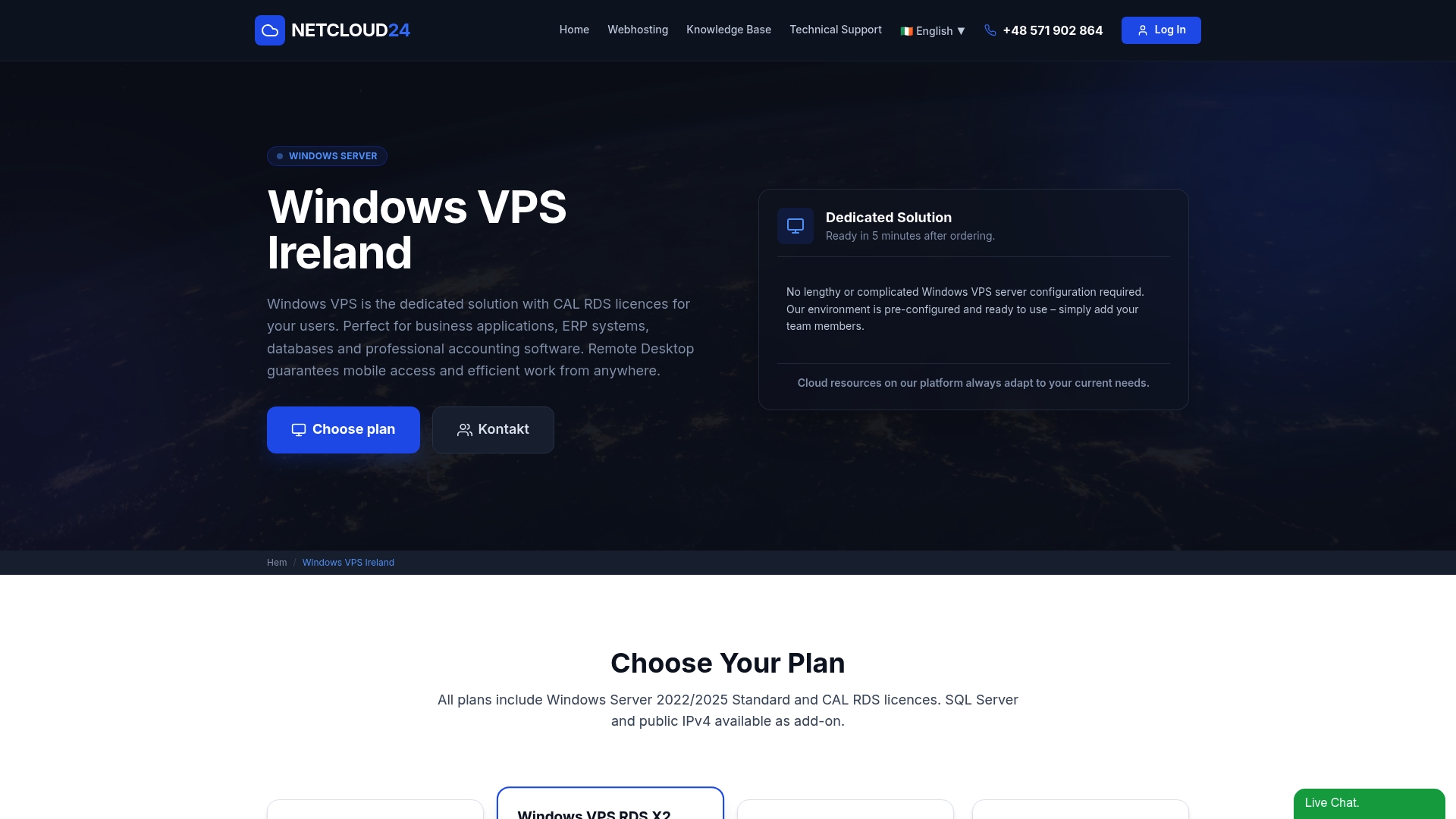
Our pre-configured environments are live in under five minutes, with automatic backups, high availability architecture, and support for Irish business applications including Sage and Xero. Whether you are running a 5-user accounting team or a 50-user ERP deployment, our scalable cloud resources grow with your business without requiring a full migration. Talk to our team today and see how quickly you can have a fully compliant, enterprise-grade Windows VPS running for your organization.
Frequently asked questions
Why is NVMe storage important for Windows VPS performance?
NVMe storage delivers input/output speeds three to five times faster than traditional SATA SSDs, which is critical for Windows Server workloads running databases, user profile disks, and enterprise applications simultaneously.
Do I need to use a VPN for RDP with Windows VPS?
Yes, always VPN RDP rather than exposing it directly to the internet, as open RDP ports are among the most actively targeted attack surfaces in enterprise IT environments.
What licensing should I check for on a Windows VPS for enterprise apps?
Verify RDS CAL inclusion along with Windows Server licensing and any application-specific licenses such as SQL Server, since missing CALs are a common and costly oversight in multi-user deployments.
Is it necessary to select an Irish or EU data center for my business VPS?
Yes, Irish/EU data centers are essential for GDPR compliance, lower latency for local users, and meeting Irish data protection obligations, making location a non-negotiable checklist item for any regulated business.
Recommended
- Secure VPS setup for enterprise access in Ireland
- Why Professional VPS Hosting Drives Secure Business Growth
- Pre-Configured VPS: Secure, Scalable Hosting for Irish Enterprises
- Microsoft SQL Windows VPS Server, IIS & ASP.NET VPS Hosting | Remote Access & RDS Ready
- VPS Security Best Practices: Defend Your Servers
- Website security checklist: protect data and build trust