
Enterprise cloud hosting is defined as the delivery of dedicated, scalable computing infrastructure over the internet, purpose-built to meet the security, compliance, and performance demands of organizations running mission-critical workloads. The enterprise cloud hosting benefits that matter most to IT and business leaders are not abstract. They are measurable: faster scaling, stronger security posture, predictable costs, and the operational agility to deploy new capabilities without waiting on hardware procurement cycles. Salesforce, Microsoft, and Google Cloud have each built their enterprise offerings around these pillars, and the gap between cloud-hosted and on-premise infrastructure widens every year.
1. Enterprise cloud hosting benefits start with on-demand scalability
Scaling on-premise infrastructure requires purchasing hardware, waiting for delivery, and configuring servers before a single workload runs. Enterprise cloud hosting eliminates that sequence entirely. Resources scale up or down in minutes, not weeks, which means your capacity matches your actual demand rather than your worst-case forecast.
The business impact is significant. Retailers handling Black Friday traffic spikes, SaaS companies launching in new markets, and financial services firms processing end-of-quarter volumes all face the same problem: demand is unpredictable. Cloud auto-scaling handles those peaks automatically, then scales back down to avoid paying for idle capacity. According to pay-as-you-go model research from Riseup Labs, this shift from capital expenditure to flexible operational expense is one of the primary financial drivers behind enterprise cloud migration.

The deeper advantage is the elimination of capacity planning guesswork. On-premise teams routinely over-provision by 30 to 40 percent to handle theoretical peaks that may never materialize. Cloud hosting converts that waste into savings.
Pro Tip: Set up cloud monitoring dashboards that track CPU, memory, and network utilization over 90-day rolling windows. Those patterns reveal your actual load variability and let you configure auto-scaling thresholds that are grounded in data rather than gut instinct.
2. How enterprise cloud hosting strengthens security and compliance
Security in the cloud operates under a framework that Salesforce calls the shared responsibility model: the cloud provider secures the underlying infrastructure, while the customer is responsible for securing their data, configurations, and access controls. Understanding where that line falls is the single most important security decision an enterprise makes when moving to the cloud.
The practical benefits of cloud-hosted security are substantial:
- Automatic patch deployment. Cloud ERP platforms apply security patches continuously, closing vulnerability windows that on-premise teams often leave open for weeks due to change management cycles.
- Compliance certifications. Cloud providers maintain SOC 2, ISO 27001, PCI DSS, and GDPR certifications through third-party audits, which reduces your own audit burden considerably.
- Built-in encryption and access control. Enterprise cloud platforms include multi-factor authentication, role-based permissions, and encryption at rest and in transit as standard features, not add-ons.
- Security dashboards. Centralized visibility into access logs, configuration drift, and anomaly detection gives security teams the situational awareness that fragmented on-premise tooling rarely provides.
Successful enterprise security also requires mapping your cloud controls to your service model. IaaS, PaaS, and SaaS each carry different responsibility boundaries, and ambiguity in those boundaries is where breaches happen. Building a control-mapping matrix that aligns your regulatory framework (GDPR, HIPAA, or PCI DSS) to your specific cloud service model removes that ambiguity before it becomes a liability.
Pro Tip: Create a one-page shared responsibility matrix for every cloud service you use. Map each control to either the provider or your team, then review it quarterly as your cloud footprint grows.
3. Performance and reliability gains from cloud infrastructure
Distributed cloud infrastructure delivers a reliability profile that on-premise data centers cannot match without enormous capital investment. Enterprise cloud providers operate across multiple geographic regions with redundant power, networking, and compute, which means a single hardware failure does not translate into downtime for your users.
The performance advantages of cloud hosting for businesses include:
- Uptime SLAs of 99.9% or higher, backed by financial penalties if providers miss them. That translates to less than nine hours of downtime per year, a standard most on-premise environments cannot guarantee.
- Geo-redundant backups and automatic failover. Cloud platforms offer disaster recovery capabilities that protect against cyberattacks, hardware failures, and natural disasters with minimal recovery time objectives.
- Elastic performance scaling. Cloud-native architectures allow compute resources to expand horizontally during demand spikes and contract afterward, maintaining consistent response times regardless of load.
"Enterprise performance improvements hinge on application architecture. Cloud-native designs provide much greater elasticity than legacy models." — Cybersecurity Magazine
The critical qualifier here is application design. Legacy monolithic architectures cannot take full advantage of cloud elasticity because they cannot scale horizontally. Microsoft 365 Copilot's microservices architecture is the clearest current example of how containerized, distributed design enables elastic AI workload scaling that a monolithic system would simply collapse under.
Pro Tip: Before migrating, audit your application portfolio for monolithic dependencies. Prioritize refactoring those workloads into containerized services before moving them to the cloud. You will see dramatically better performance outcomes than a lift-and-shift approach delivers.
4. Business agility and operational efficiency through cloud hosting
Cloud hosting advantages extend well beyond infrastructure. The operational model of enterprise cloud hosting changes how quickly your organization can respond to market conditions, deploy new capabilities, and support a distributed workforce.
Cloud ERP platforms like SAP S/4HANA Cloud and Oracle Fusion eliminate the disruptive upgrade cycles that on-premise deployments require. Automatic updates deploy continuously, which means your teams always work on the current version without scheduling weekend maintenance windows or paying consultants to manage upgrade projects. That alone recovers hundreds of hours of IT capacity per year in mid-size enterprises.
The agility benefits compound across the organization:
- Faster deployment of new applications reduces time to market from months to days.
- Native integrations with CRM platforms, payment systems, and analytics tools replace custom middleware that requires ongoing maintenance.
- Anywhere access via browser or remote desktop supports distributed and hybrid teams without VPN complexity.
- Rapid experimentation with AI and analytics tools becomes practical when provisioning a new environment takes minutes rather than weeks.
Cloud hosting also reduces the IT overhead associated with managing physical infrastructure. Server patching, hardware replacement, and data center operations shift to the provider, freeing your IT team to focus on building capabilities rather than maintaining systems. That reallocation of technical talent is one of the most underappreciated advantages of cloud solutions for organizations competing on speed.
Pro Tip: Adopt cloud-native SaaS platforms for your core business functions wherever possible. The continuous delivery model those platforms use means you benefit from new features automatically, without the friction of traditional software release cycles.
5. Cost flexibility and sustainability advantages
Enterprise cloud hosting converts unpredictable capital expenditure into predictable operational spending. There are no upfront hardware purchases, no depreciation schedules, and no stranded capacity when business conditions change. Subscription pricing and pay-as-you-go consumption models mean your IT costs scale with your actual usage.
The financial case is well documented. Enterprises realize up to 30% lower total cost of ownership within two years of migrating workloads to cloud. One global manufacturer saved over $4 million annually after migration, a figure that reflects both direct infrastructure savings and the elimination of maintenance overhead.
The sustainability dimension is equally significant for organizations with ESG commitments:
- Cloud data centers achieve energy efficiency levels that most private data centers cannot approach, through advanced cooling systems, renewable energy procurement, and hardware utilization rates that far exceed on-premise averages.
- Migrating workloads to cloud infrastructure can reduce IT-related carbon emissions by up to 80%, according to Riseup Labs research citing cloud provider sustainability data.
- Consolidated cloud infrastructure eliminates the energy waste of underutilized on-premise servers, which typically run at 10 to 15 percent utilization.
For organizations reporting under ESG frameworks, cloud providers offer sustainability dashboards and carbon reporting tools that make emissions tracking straightforward. That reporting capability is increasingly a procurement requirement from enterprise customers and a board-level expectation.
Pro Tip: When evaluating cloud vendors, request their sustainability reports and ask specifically about renewable energy commitments in the regions where your data will reside. That data belongs in your vendor scorecard alongside price and SLA terms.
6. Remote access and workforce enablement as a cloud hosting feature
Enterprise cloud hosting features include secure, high-performance remote access that supports modern workforce models without the complexity of traditional VPN infrastructure. Remote Desktop Services (RDS) on Windows Server environments, for example, allow multiple users to access shared business applications simultaneously from any device and location.
This capability matters most for organizations running ERP systems, accounting platforms like Sage or Xero, and database-driven business applications that require consistent performance regardless of where users connect from. A scalable cloud server environment with RDS licensing included removes the per-seat complexity of traditional remote access licensing while maintaining the access controls and audit trails that compliance requires.
The workforce enablement benefits extend to IT administration as well. Centralized cloud environments are easier to patch, monitor, and secure than distributed endpoint configurations. When a security policy changes, it applies across all sessions immediately rather than waiting for individual devices to check in. For organizations managing secure enterprise access across multiple locations, that centralized control model reduces both risk and administrative overhead.
Key takeaways
Enterprise cloud hosting delivers measurable advantages across scalability, security, performance, cost efficiency, and workforce enablement, making it the default infrastructure choice for organizations that compete on speed and reliability.
| Point | Details |
|---|---|
| Scalability is immediate | Cloud resources scale in minutes, eliminating over-provisioning and hardware procurement delays. |
| Security is a shared responsibility | Enterprises must actively manage their data and configurations; providers secure the infrastructure. |
| Performance depends on architecture | Cloud-native, containerized designs deliver far greater elasticity than migrated monolithic applications. |
| Cost shifts from CAPEX to OPEX | Pay-as-you-go pricing and up to 30% lower TCO make cloud migration a strong financial decision. |
| Sustainability is quantifiable | Cloud migration can reduce IT-related carbon emissions by up to 80%, supporting ESG reporting goals. |
Why I think most enterprises underestimate the security benefit
After working with organizations across multiple cloud platforms including Microsoft Azure, Salesforce, and Google Cloud, the pattern I see most consistently is this: IT leaders focus heavily on cost and scalability when evaluating cloud hosting, and treat security as a checkbox rather than a strategic advantage. That ordering is backwards.
The shared responsibility model is not a limitation. It is a forcing function that makes enterprises articulate their security posture in writing, often for the first time. The organizations that do that work properly end up with cleaner access controls, better audit trails, and faster incident response than they ever had on-premise. The ones that skip it assume the cloud provider handles everything and discover the gap during an audit or, worse, a breach.
I have also seen the automatic patching benefit consistently undervalued. On-premise teams routinely delay patches by weeks because of change management processes and testing requirements. Cloud ERP platforms apply those same patches continuously and transparently. That single operational difference closes more vulnerability windows than most dedicated security tools do. If you are evaluating the compliance and protection case for cloud hosting, start with the patching cadence comparison. The numbers are more persuasive than any marketing claim.
My honest recommendation: treat your cloud migration as an architecture project, not an infrastructure project. The enterprises that move workloads without rethinking application design get modest gains. The ones that refactor for cloud-native patterns get the full benefit stack.
— Lukasz
Netcloud24 enterprise cloud hosting for Windows and RDS environments
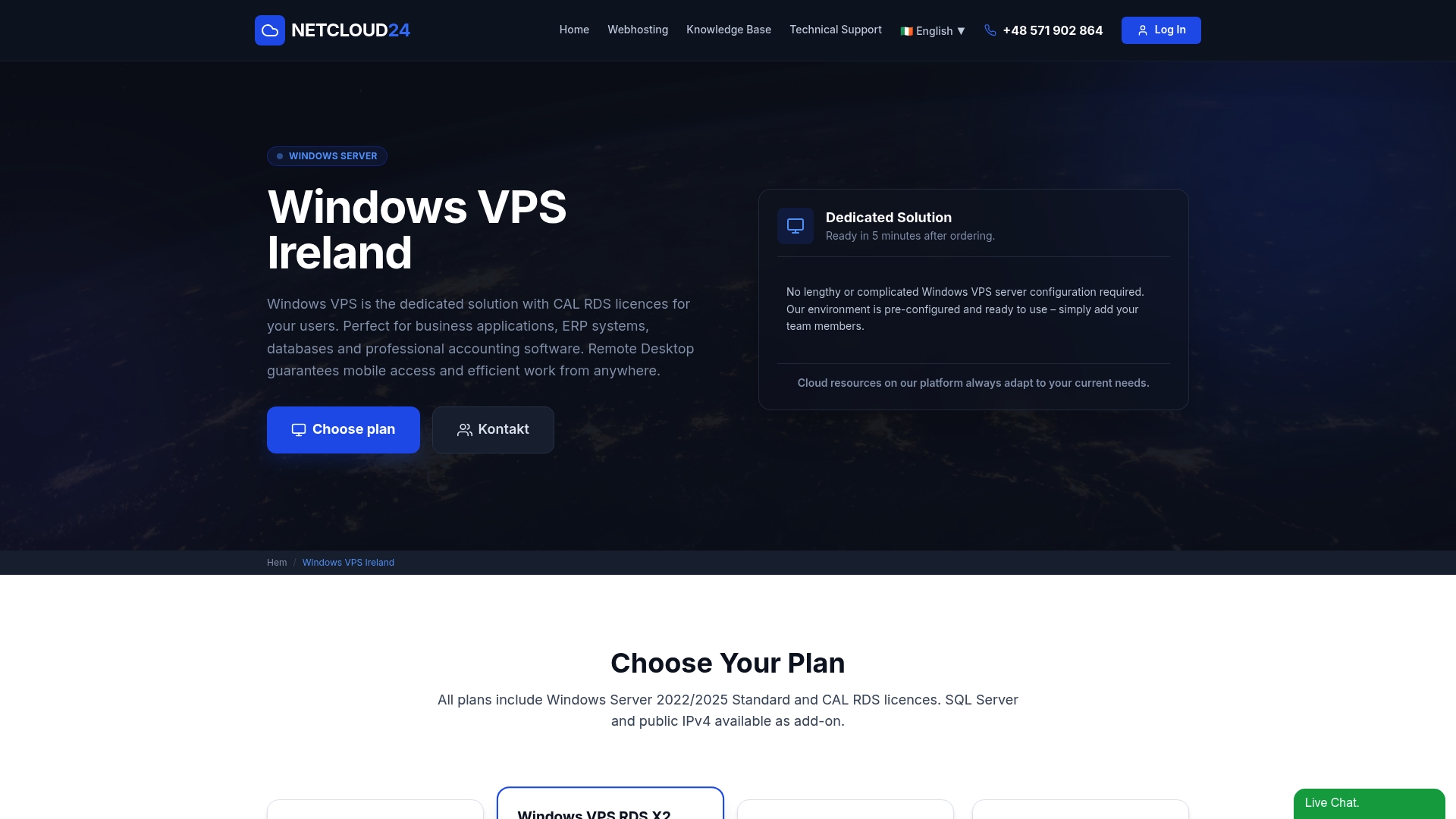
If the benefits covered in this article align with what your organization needs, Netcloud24 delivers them in a pre-configured, enterprise-grade environment built specifically for Irish businesses. The platform provides Windows VPS hosting with RDS licensing included, NVMe enterprise storage, high availability infrastructure, and deployment in under five minutes. It is designed for organizations running ERP systems, accounting software like Sage and Xero, and database-driven business applications that require consistent performance and secure multi-user remote access. GDPR compliance, automatic backups, built-in firewall protection, and VPN access are included as standard. Netcloud24 handles the infrastructure so your IT team focuses on the work that matters.
FAQ
What are the main enterprise cloud hosting benefits?
Enterprise cloud hosting delivers on-demand scalability, automatic security patching, compliance certifications, disaster recovery, and predictable operational costs. These advantages combine to reduce IT overhead while improving reliability and security posture.
How does the shared responsibility model affect enterprise cloud security?
The cloud provider secures the underlying infrastructure, while the enterprise is responsible for securing its data, user configurations, and access controls. Mapping those responsibilities clearly to your service model (IaaS, PaaS, or SaaS) is the foundation of effective cloud security.
Can cloud hosting reduce IT costs for enterprises?
Enterprises that migrate workloads to cloud infrastructure realize up to 30% lower total cost of ownership within two years, according to Riseup Labs. The shift from capital expenditure to pay-as-you-go operational spending eliminates upfront hardware costs and stranded capacity.
Why does application architecture matter for cloud performance?
Cloud performance gains depend on workloads being designed for horizontal scaling through containers and microservices. Legacy monolithic applications migrated without refactoring cannot take advantage of cloud elasticity and often deliver disappointing performance results.
How does enterprise cloud hosting support compliance requirements?
Cloud providers maintain certifications including SOC 2, ISO 27001, PCI DSS, and GDPR through ongoing third-party audits. Those certifications reduce the compliance burden on enterprise customers and provide documented evidence for regulatory reporting.