
Choosing the right server environment for your enterprise applications is one of the most consequential infrastructure decisions an Irish IT manager or business owner can make. Get it wrong, and you are looking at performance bottlenecks, audit failures, and GDPR exposure that no policy document can fix. Get it right, and you have a scalable, compliant foundation that grows with your business without the overhead of managing physical hardware. This article covers the most impactful VPS use cases, the features that matter for Irish compliance, and a practical framework for matching server resources to your actual workload needs.
Table of Contents
- What makes VPS hosting ideal for Irish businesses?
- Top 7 VPS use cases for secure business growth
- Comparing VPS for performance and compliance
- How to match VPS to your business use case
- The hard truth about VPS for Irish enterprises
- Discover secure, compliant VPS hosting options
- Frequently asked questions
Key Takeaways
| Point | Details |
|---|---|
| Compliance starts at infrastructure | VPS hosting supports GDPR by keeping data in Ireland/EU and providing audit, encryption, and access controls. |
| Seven key VPS use cases | From business apps to remote desktops and trading, VPS enables secure, resilient hosting across sectors. |
| Performance data drives decisions | Use real benchmarks and compare vendor compliance features to match your needs. |
| Plan for growth early | Right-size your VPS for current loads but consider scalability as your business expands. |
| Real compliance is ongoing | Documented controls plus regular audits keep your hosting compliant—not just a signed policy. |
What makes VPS hosting ideal for Irish businesses?
A Virtual Private Server gives your business dedicated, isolated resources on a shared physical machine. Unlike shared hosting, where RAM and CPU are split unpredictably among dozens of tenants, a VPS allocates guaranteed resources exclusively to your environment. That predictability matters enormously when you are running business-critical applications like ERP systems, accounting software, or databases that cannot tolerate sudden performance drops.
For Irish businesses, the advantages of VPS go well beyond raw performance. Three specific factors make VPS a strong fit for the Irish enterprise market:
- Dedicated resources at managed cost. You get the isolation of a dedicated server without the capital expense. Scaling up usually means a quick plan change, not a hardware procurement cycle.
- GDPR-aligned infrastructure controls. As confirmed by GDPR hosting guidance for Ireland, VPS placement and operational controls, including encryption, audit trails, access logging, and data residency, are core components of a credible GDPR strategy. A policy document without the infrastructure to back it up means very little at audit time.
- Better compliance posture than shared hosting. On a shared server, you have limited visibility into who else occupies that environment or how data is isolated. A VPS gives you a clearly bounded environment with enforceable data boundaries.
When businesses need secure, scalable hosting in Ireland, the VPS model hits a sweet spot between cost efficiency and enterprise control. It outperforms shared hosting for any workload that carries compliance obligations, and it is far more cost-effective than a fully dedicated physical server for most small to medium enterprise workloads.
"Your GDPR obligations do not live in your privacy policy. They live in your servers."
Pro Tip: Before selecting a VPS plan, confirm the physical data center location. Hosting EU citizen data on servers outside the European Economic Area introduces additional compliance complexity under GDPR Article 46. Ireland-based or EU-based server locations simplify your legal basis considerably.
Review the full VPS security checklist to make sure your chosen environment covers access control, logging, and encryption at rest and in transit.
Top 7 VPS use cases for secure business growth
Now that you know the core strengths of VPS, let's consider the most impactful real-world scenarios in Irish businesses. These are not theoretical applications. They are the use cases that IT leaders across sectors in Ireland are actively deploying today.
-
Business-critical application hosting. Running an ERP, CRM, or accounting platform like Sage or Xero on a VPS ensures your team always has reliable, fast access. Multi-user access through Windows Remote Desktop Services means ten or fifteen staff members can work simultaneously in the same environment, with IT maintaining full control over permissions and updates.
-
GDPR-compliant web and data hosting. Irish businesses handling customer data, financial records, or health information need hosting that can demonstrate data residency, access control, and processing accountability. A VPS with documented audit trails puts you in a defensible position for cloud compliance in Irish businesses.
-
Secure remote desktop and collaboration environments. Post-pandemic work patterns have normalized remote access for entire teams. A Windows VPS with Remote Desktop Services provides a stable, centrally managed workspace that employees can reach from any device without compromising security. VPN access adds a further authentication layer.
-
Trading and low-latency platforms. As trading VPS research demonstrates, use cases for financial trading require 24/7 uptime, consistent execution windows, and stable environment behavior. Shared hosting simply cannot deliver those guarantees. A VPS keeps your trading application running even when your local machine is offline or your internet connection fluctuates.
-
Development and test automation labs. Development teams often need isolated environments to test new releases without touching production. Spinning up a VPS as a dev or staging server is fast, cost-effective, and disposable when the project ends. Automated testing pipelines can run overnight without competing for resources.
-
Email and communications servers. Running your own email infrastructure on a VPS gives you control over spam filtering, retention policies, and encryption. For regulated industries, this also means you control where messages are stored and who has access to them, removing dependency on a third-party email provider whose compliance posture you cannot directly audit.
-
Disaster recovery and backup infrastructure. A VPS makes an excellent failover or backup target for your primary on-premises systems. With automatic snapshot capabilities and offsite replication to an Irish data center, your business can meet recovery time objectives without investing in a full secondary data center.
The business impact of VPS hosting across these seven scenarios comes down to one consistent theme: dedicated resources plus operational control equal better outcomes for security, performance, and compliance.
Statistic callout: Organizations that experience a data breach while lacking documented infrastructure controls face significantly higher regulatory fines and reputational damage than those with auditable, well-managed server environments. Data residency alone does not satisfy GDPR; operational accountability does.
Pro Tip: For trading or low-latency applications, ask your VPS provider specifically about network path optimization between their Irish data center and your primary exchange or financial platform. A few milliseconds in latency can matter more than raw CPU power for this use case.
Comparing VPS for performance and compliance
But which VPS is right for which use case? To make the call, you need evidence-driven comparisons focused on both compliance and performance. Not all VPS plans are created equal, even when the pricing looks similar on paper.
Empirical benchmarks for Irish VPS providers are available from independent testing services, giving IT managers measured CPU performance, disk throughput, and network speed scores for servers located in Dublin. These benchmarks are invaluable because they replace vendor marketing with actual numbers collected under controlled conditions.
Here is a comparison of VPS feature categories most relevant to Irish enterprise decisions:
| Feature | What to look for | Why it matters for Irish businesses |
|---|---|---|
| Data center location | Ireland or EU-based | Simplifies GDPR data residency compliance |
| Storage type | NVMe SSD enterprise grade | Faster read/write for databases and ERP apps |
| Documented compliance | GDPR, ISO, SOC alignment | Supports audit and procurement requirements |
| Audit and logging | Access logs, change logs, event trails | Essential for GDPR accountability obligations |
| Backup and recovery | Automated, tested, offsite | Meets business continuity requirements |
| Scalability | On-demand resource upgrades | Handles business growth without migration |
| Support SLA | 24/7 technical support | Critical for business-hours incident response |
| OS licensing | Windows Server with RDS included | Reduces cost and complexity for multi-user access |
When interpreting VPS benchmark results, focus on three numbers: the geekbench CPU score for compute-heavy workloads, the disk sequential read/write speed for database operations, and the network throughput for applications with heavy data transfer requirements. A plan with an outstanding CPU score but slow disk performance will still bottleneck your SQL Server database.
"Performance numbers without compliance documentation are half the story. You need both before you commit to a provider."
To compare Windows VPS options across providers effectively, build a short requirements matrix before you contact vendors. List your top three workloads, their peak resource needs, your compliance obligations, and your recovery time objective. Then score each vendor against those criteria rather than against their own marketing claims.
For IT teams supporting remote workers, VPS performance for remote work depends heavily on network latency between your data center and employee locations. An Ireland-based VPS reduces that latency for Irish users compared to servers hosted in the UK or continental Europe.

How to match VPS to your business use case
Armed with feature and performance data, your next step is making a decision. Here is a step-by-step approach that removes guesswork and keeps your compliance obligations front and center.
-
Map your workloads and compliance drivers. List every application you plan to host and flag which ones handle personal data, financial records, or sensitive business information. These flagged applications drive your compliance requirements.
-
Confirm data residency and processing agreements. Ask every vendor to provide written confirmation of where your data physically resides and whether they will sign a GDPR Data Processing Agreement. This is not optional for Irish businesses handling EU personal data.
-
Evaluate scalability headroom. Check whether your VPS plan allows you to add CPU, RAM, or storage without migrating to a new server. The ability to scale vertically without downtime is critical for growing businesses. Setting up secure VPS in Ireland correctly from the start includes planning the headroom you need at month twelve, not just day one.
-
Test audit and logging controls. Before signing a contract, ask the vendor to demonstrate their logging interface. You should be able to see login events, configuration changes, and data access records. If the vendor cannot show you this, treat it as a red flag.
-
Understand the cost-to-scale trade-off. Entry-level VPS plans are inexpensive, but costs rise as you add resources. Build a twelve-month cost projection that includes both your base plan and expected scaling. Compare that against the cost of a dedicated server to confirm you are in the right product category.
As GDPR hosting experts explain, GDPR readiness must be treated as an infrastructure and operations problem, covering data residency, Data Processing Agreement accountability, logging, auditability, encryption, and role-based access control. A vendor who only hands you a policy document and calls it compliance has not actually given you compliance.
| Workload type | Minimum recommended resources | Key compliance feature |
|---|---|---|
| ERP or accounting app (5-10 users) | 4 vCPU, 8 GB RAM, 100 GB NVMe | RDS licensing, access logs |
| Database server | 4 vCPU, 16 GB RAM, 200 GB NVMe | Encryption at rest, automated backup |
| Remote desktop environment | 6 vCPU, 12 GB RAM, 80 GB NVMe | VPN, MFA, session logging |
| Dev/test environment | 2 vCPU, 4 GB RAM, 50 GB NVMe | Isolated network, snapshot capability |
| Email server | 2 vCPU, 4 GB RAM, 100 GB NVMe | Encryption in transit, retention policy |
Pro Tip: Always request a vendor's incident response process in writing before you sign. How quickly will they notify you of a breach? What logs will they provide? These questions often reveal more about a vendor's actual security posture than any certification badge on their website.
The hard truth about VPS for Irish enterprises
Let's step back and address what actually works for compliance and resilience, not just what sounds good on paper.
Most organizations we speak to believe their GDPR compliance is sorted because they have a privacy policy posted on their website and a data processing register in a spreadsheet somewhere. That is not compliance. That is paperwork. When a Data Protection Commission inspector asks for evidence of your processing controls, they want to see logs, access records, encryption configurations, and incident response timelines. If your hosting infrastructure cannot produce those, your policy document is irrelevant.
The second misconception is that scaling is always easy. It is easy when you plan for it. It becomes expensive and risky when a traffic spike or a sudden business acquisition catches you on the minimum plan with no headroom. We have seen businesses migrate their entire ERP environment under time pressure because they outgrew their VPS plan during a busy quarter. That kind of emergency migration introduces downtime, data handling risk, and exactly the kind of operational chaos that compliance frameworks are designed to prevent.
Real compliance is not a checkbox you tick when you sign a contract with an Irish hosting provider. It is a continuous operational mindset. It means regular audit log reviews, tested backup restoration procedures, timely software patching, and role-based access control that is actually enforced rather than just documented. The professional VPS hosting benefits that matter most are the ones that support this ongoing operational discipline: automated backups you can test, access controls you can report on, and a provider who treats your DPA as a real obligation rather than a boilerplate document.
Buy for where you will be in twelve months, not where you are today. And treat every compliance control as a live operational requirement, not a one-time implementation task.
Discover secure, compliant VPS hosting options
If you're ready to put these lessons into action, here are next steps for your VPS search.
Choosing a VPS provider for your Irish enterprise means more than picking a price point. It means selecting a partner who understands that your infrastructure is part of your compliance program. Irish and EU data center locations, documented processing agreements, NVMe enterprise storage, and pre-configured Windows environments reduce your setup time and your risk simultaneously.
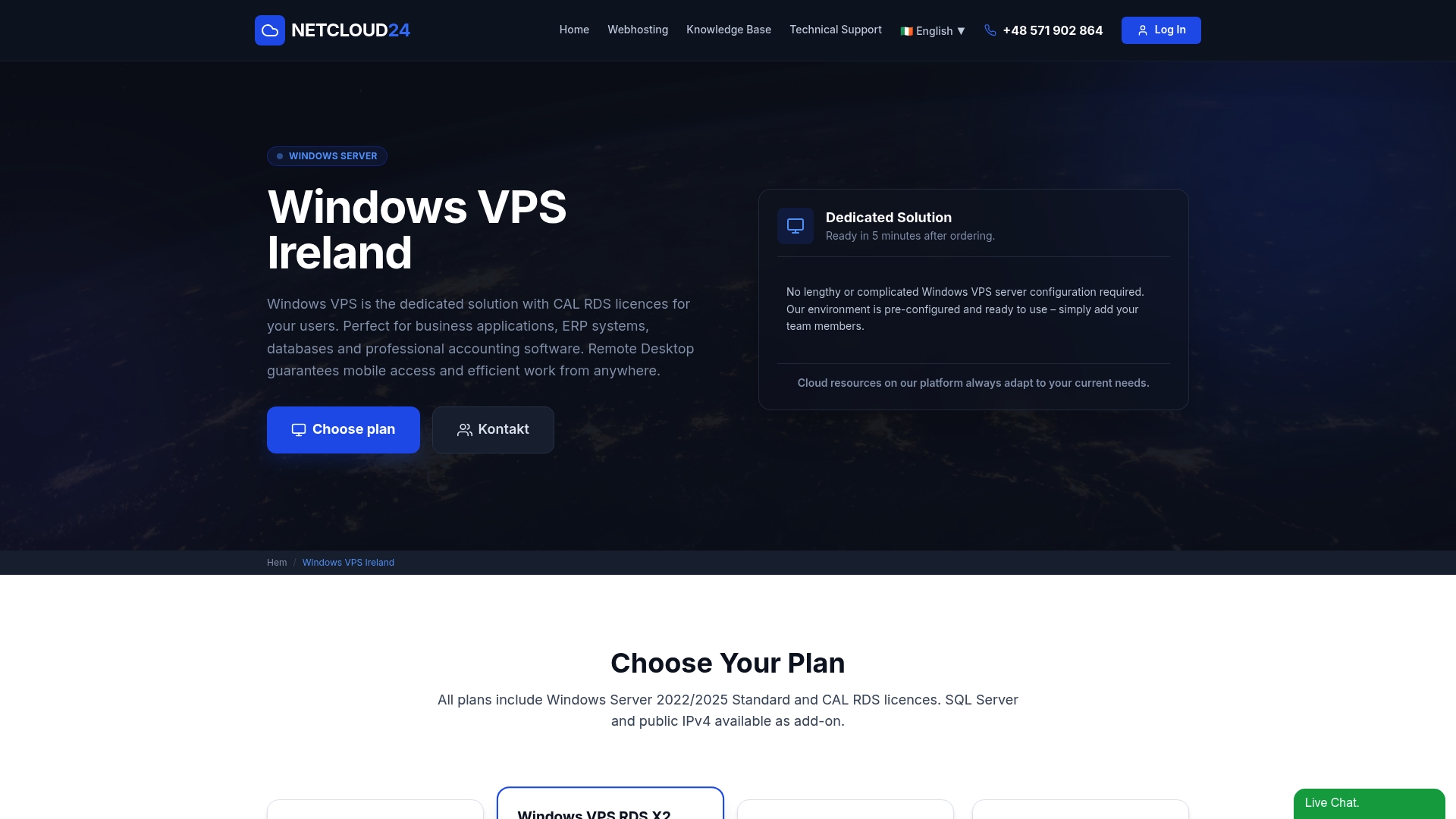
At NetCloud24 Ireland, enterprise-grade VPS environments include Windows Server with RDS licensing, NVMe storage, VPN access, and automatic backups, all configured and ready within minutes. If you want to understand exactly what a pre-configured VPS solution looks like in practice, that resource walks through what is included and why the setup choices matter for Irish business compliance. Start your evaluation with a clear requirements list, and you will find the right fit faster than you think.
Frequently asked questions
Which VPS features are essential for GDPR compliance in Ireland?
Key features include Irish/EU data residency, robust encryption, audit trails, role-based access control, and enforceable data processing agreements. As GDPR hosting guidance confirms, VPS placement and operational controls are core components of any credible GDPR-aligned hosting strategy.
Can a VPS support both trading platforms and standard business applications?
Yes, a VPS provides the dedicated resources and guaranteed uptime that trading platforms require, while also supporting standard business apps in the same or separate isolated environments. Trading-focused VPS research confirms that consistent execution windows and 24/7 availability are defining requirements for this use case.
How do I find reliable VPS performance benchmarks for Ireland?
Independent services publish empirical benchmarks for Ireland-located VPS plans, including measured CPU, disk, and network scores that let you compare providers without relying on vendor marketing materials.
Is a VPS always the right scaling solution for a growing business?
A VPS handles most growth scenarios well, but fast-growing businesses should plan ahead for the point at which dedicated resources or clustered cloud infrastructure may become necessary to avoid emergency migrations during peak demand periods.
What audit controls should I request from an Irish VPS provider?
Request documented access logging, configuration change tracking, and data access traceability aligned to EU standards. Providers who treat GDPR operational controls seriously will be able to demonstrate these capabilities before you sign a contract, not just promise them in a brochure.